Abstract
Sand mining in small, steep hill rivers remains poorly quantified despite rising global concern over aggregate-driven ecological degradation. This study develops an integrated, indicator-based framework to evaluate the environmental and socio-economic impacts of manual and mechanical sand mining along the Langkaih River, Mizoram, Northeast India—a transboundary hill river recently subjected to a ban on mechanized extraction. Water quality was assessed at upstream, active, and downstream sites using the Water Quality Index (WQI) and a novel Water Quality Impact Gradient (WQIG), combined with turbidity analysis and livelihood surveys. These datasets informed two composite indicators—the Sand Mining Vulnerability Index (SMVI) and an Integrated Sustainability Index (ISI)—linking environmental pressure, socio-economic dependence, and adaptive capacity. Results show that mechanical suction mining generated extreme turbidity plumes and WQI deterioration from “Poor” to “Unsuitable for drinking,” with a 470% WQIG increase and high vulnerability (SMVI ≈ 64). Manual extraction caused moderate, reversible impacts (WQIG = −29%), higher employment intensity, and greater overall sustainability (ISI = 0.91 vs. 0.27). The framework transparently differentiates mining methods by environmental and livelihood performance, supporting evidence-based regulation in data-limited hill systems. The findings provide a transferable model for sustainable sand governance to protect drinking-water security and riverine ecosystem health across Himalayan and tropical basins.
Keywords
Sand Mining, Socio-Economic Analysis, Water Quality, Ecological Impacts, Langkaih River
1. Introduction
Sand, as a foundational input to construction and infrastructure, has become a strategic development resource, but its extraction from river systems increasingly exposes deep tensions between growth and ecological integrity. Global assessments show that accelerating demand for construction aggregates has transformed river sand mining from a local livelihood activity into a major driver of channel incision, habitat loss, water quality deterioration and social conflict
| [30] | Kjelland, M. E., Woodley, C. M., Swannack, T. M., & Smith, D. L. (2015). A review of the potential effects of suspended sediment on fishes. Environment Systems and Decisions, 35(3), 334-350. |
| [32] | Kondolf, G. M. (1994). Geomorphic and environmental effects of instream gravel mining. Landscape and Urban Planning, 28(2-3), 225-243. |
| [33] | Kondolf, G. M. (1997). Hungry water: Effects of dams and gravel mining on river channels. Environmental Management, 21(4), 533-551. |
| [43] | Ojukwu, H. S., Umemezia, E. I., Agbadudu, J. E., & Azotani, F. C. (2022). Sand mining: Economic gains, environmental ethics, and policy implications. African Journal of Economics and Sustainable Development, 5(2), 119-138. |
| [47] | Pitchaiah, P. S. (2017). Anthropogenic impacts of sand mining in terms of geo-environmental issues of Kotaheru River Basin, Andhra Pradesh, India. International Journal of Geology, Earth and Environmental Sciences, 7(3), 19-27. |
| [49] | Sreebha, S., & Padmalal, D. (2011). Environmental impact assessment of sand mining from small catchment rivers in the southwestern coast of India: A case study. Environmental Management, 47(1), 130-140. |
[30, 32, 33, 43, 47, 49]
. Emerging evidence from Asia and Africa further highlights how weak regulation and mechanised extraction amplify environmental risk while concentrating economic gains, particularly in fragile or data-poor settings
| [10] | Bhatawdekar, R. M., Singh, T. N., Mohamad, E. T., Armaghani, D. J., & Hasbollah, D. Z. B. A. (2021). River sand mining vis-à-vis manufactured sand for sustainability. In Lecture Notes in Civil Engineering (Vol. 109). Springer. |
| [25] | Iversen, L. L., et al. (2024). Environmental and socio-economic impacts of river sand mining: A quick scoping review. [Report]. |
| [26] | Jain, P., & Dohare, D. (2022). Water quality index and its application: A review. Water Practice and Technology, 17(8), 1822-1836. |
| [45] | Padmalal, D., Maya, K., Sreebha, S., & Sreeja, R. (2008). Environmental effects of river sand mining: A case from the river catchments of Vembanad Lake, southwest coast of India. Environmental Geology, 54(4), 879-889. |
[10, 25, 26, 45]
. Yet hill rivers, which differ markedly from large alluvial systems in gradient, morphology, hydrology, and community dependence, remain critically under-represented in this debate.
The Langkaih River in Mizoram, Northeast India, exemplifies these intertwined pressures. It has functioned as a principal source of construction-grade sand for much of southern Mizoram, supporting public infrastructure, private building and a network of local employment. At the same time, rapid expansion of mechanical suction dredging along confined, erosion-prone reaches has triggered visible bank failure, bed degradation, increased turbidity and declining aquatic life, reinforcing concerns raised in broader studies of unsustainable sand extraction
| [9] | Berry, W., Newcombe, C. P., & Clarke, L. (2003). The biological effects of suspended and bedded sediment (SABS) in aquatic systems: A review. U.S. Environmental Protection Agency. |
| [22] | Han, Y., Li, Q., Wang, L., Zhang, Y., & Lu, Y. (2023). Effects of dredging and sand mining on fish communities and habitats: A global synthesis. Proceedings of the Royal Society B, 290. |
| [39] | Naveen Saviour, M. (2012). Environmental impact of soil and sand mining: A review. International Journal of Science, Environment and Technology, 1(3), 125-134. |
[9, 22, 39]
. In response to sustained advocacy by environmental groups and mounting field-based observations of ecological damage, the Government of Mizoram imposed a ban on sand mining in the Langkaih River on 9 May 2023, with particular emphasis on the destructive impacts of mechanised suction. This abrupt policy shift underscores a wider governance dilemma: how to safeguard vulnerable riverine ecosystems and drinking water sources without undermining construction needs, exacerbating livelihood insecurity, or displacing harmful practices to less regulated sites.
Despite growing recognition of a global “sand crisis,” three critical gaps constrain evidence-based decision-making for hill states like Mizoram. First, most empirical work in India and elsewhere focuses on large alluvial rivers, with limited attention to steep, narrow hill rivers where geomorphic sensitivity and community dependence may heighten risk
| [29] | Kumari, N., Pandey, S., & Kumar, G. (2024). Sand mining: A silent threat to the river ecosystem. In Rivers of India: Past, Present and Future (pp. 109-132). Cham: Springer International Publishing. |
| [43] | Ojukwu, H. S., Umemezia, E. I., Agbadudu, J. E., & Azotani, F. C. (2022). Sand mining: Economic gains, environmental ethics, and policy implications. African Journal of Economics and Sustainable Development, 5(2), 119-138. |
| [47] | Pitchaiah, P. S. (2017). Anthropogenic impacts of sand mining in terms of geo-environmental issues of Kotaheru River Basin, Andhra Pradesh, India. International Journal of Geology, Earth and Environmental Sciences, 7(3), 19-27. |
[29, 43, 47]
. Second, method-specific impacts of manual versus mechanical extraction are rarely quantified within a single river system using harmonised field data; as a result, regulatory debates often treat all sand mining as uniformly harmful or uniformly necessary. Third, few studies integrate water quality changes, livelihood benefits, infrastructure exposure and local adaptive capacity into transparent, operational indicators that can support differentiated licensing, spatial targeting and phased restriction of high-risk practices
| [19] | Gómez-Limón, J. A., & Sanchez-Fernandez, G. (2010). Empirical evaluation of agricultural sustainability using composite indicators. Ecological Economics, 69(5), 1062-1075. |
| [30] | Kjelland, M. E., Woodley, C. M., Swannack, T. M., & Smith, D. L. (2015). A review of the potential effects of suspended sediment on fishes. Environment Systems and Decisions, 35(3), 334-350. |
| [36] | Mishra, A., Das, S. K., & Reddy, K. R. (2023). Life cycle triple bottom line sustainability assessment of coal mine overburden sand versus river sand. Resources Policy, 86, 104140. |
[19, 30, 36]
.
This study addresses these gaps through an integrated assessment of manual and mechanical sand mining along the Langkaih River. It combines physicochemical monitoring at upstream, at-site and downstream locations with an impact gradient approach, multivariate analysis, vendor-level livelihood and profitability surveys, and composite indices of sand mining vulnerability and sustainability. The novelty lies in four elements: (i) a direct empirical comparison of manual and mechanical extraction in a steep hill river context subject to an actual regulatory ban; (ii) the development of simple gradient-based indicators of water quality and turbidity that capture the spatial footprint of mining impacts; (iii) the construction of a Sand Mining Vulnerability Index that links extraction pressure, environmental sensitivity, socio-economic exposure, infrastructure risk and adaptive capacity; and (iv) an Integrated Sustainability Index that evaluates whether method-specific livelihood gains justify documented ecological costs. Together, these tools generate a transferable, decision-oriented framework for aligning sand mining governance in hill river systems with the principles of sustainable development and environmental justice.
2. Literature Review
The global construction boom has caused an unprecedented demand for sand, making sand mining a critical activity worldwide
| [10] | Bhatawdekar, R. M., Singh, T. N., Mohamad, E. T., Armaghani, D. J., & Hasbollah, D. Z. B. A. (2021). River sand mining vis-à-vis manufactured sand for sustainability. In Lecture Notes in Civil Engineering (Vol. 109). Springer. |
| [47] | Pitchaiah, P. S. (2017). Anthropogenic impacts of sand mining in terms of geo-environmental issues of Kotaheru River Basin, Andhra Pradesh, India. International Journal of Geology, Earth and Environmental Sciences, 7(3), 19-27. |
[10, 47]
. River sand mining, in particular, is driven by the need for concrete and other construction materials, with extraction rates having tripled in the last two decades and reaching up to 40 billion tonnes per year
| [10] | Bhatawdekar, R. M., Singh, T. N., Mohamad, E. T., Armaghani, D. J., & Hasbollah, D. Z. B. A. (2021). River sand mining vis-à-vis manufactured sand for sustainability. In Lecture Notes in Civil Engineering (Vol. 109). Springer. |
| [22] | Han, Y., Li, Q., Wang, L., Zhang, Y., & Lu, Y. (2023). Effects of dredging and sand mining on fish communities and habitats: A global synthesis. Proceedings of the Royal Society B, 290. |
| [26] | Jain, P., & Dohare, D. (2022). Water quality index and its application: A review. Water Practice and Technology, 17(8), 1822-1836. |
[10, 22, 26]
. Critical hotspots for extraction include China, India, and various African countries, where both legal and illegal mining are widespread
| [25] | Iversen, L. L., et al. (2024). Environmental and socio-economic impacts of river sand mining: A quick scoping review. [Report]. |
| [37] | Mori, K., & Christodoulou, A. (2012). Review of sustainability indices and indicators: Towards a new City Sustainability Index (CSI). Environmental Impact Assessment Review, 32(1), 94-106. |
[25, 37]
.
The intensification of in-stream sand mining in developing regions has provoked widespread concerns regarding both environmental degradation and socio-economic challenges. Sand and gravel extraction, while serving critical roles in construction and local economies, often leads to severe disturbances in river ecosystems and communities
| [20] | Gopal, T. V. R. (2025). River sand and gravel mining: Striking a balance between ecology and economy. International Journal of Environment and Ecology Studies, 5(1), 1-16. |
| [54] | Wiejaczka, Ł., Tamang, L., Piróg, D., & Prokop, P. (2018). Socio-environmental issues of river bed material extraction in the Himalayan piedmont (India). Environmental Earth Sciences, 77, 718. |
[20, 54]
.
Recent studies document the loss of in-stream habitats and biodiversity due to excessive sand mining, with implications for riverine vegetation and aquatic species
| [20] | Gopal, T. V. R. (2025). River sand and gravel mining: Striking a balance between ecology and economy. International Journal of Environment and Ecology Studies, 5(1), 1-16. |
| [29] | Kumari, N., Pandey, S., & Kumar, G. (2024). Sand mining: A silent threat to the river ecosystem. In Rivers of India: Past, Present and Future (pp. 109-132). Cham: Springer International Publishing. |
[20, 29]
. Unregulated sand extraction alters the hydraulic regime of rivers, depletes groundwater, reduces water retention capacity, and accelerates bank erosion
| [34] | Kondolf, G. M., Smeltzer, M., & Kimball, L. (2002). Freshwater gravel mining and dredging issues. Center for Environmental Design Research. |
[34]
. In India, in-stream mining has resulted in significant changes in channel morphology, deteriorated water quality, and the collapse of riverbanks, which together threaten long-term ecosystem services.
Sand mining has been shown to significantly alter river morphology, cause riverbed lowering and widening, and contribute to bank and dune erosion
| [48] | Rentier, E. S., & Cammeraat, L. H. (2022). The environmental impacts of river sand mining. Science of The Total Environment, 838(1), 155877. |
[48]
. For example, in Southern Monterey Bay, USA, intensive sand mining was responsible for about half of the yearly average dune volume loss and long-term beach erosion until the cessation of mining reduced these rates
| [48] | Rentier, E. S., & Cammeraat, L. H. (2022). The environmental impacts of river sand mining. Science of The Total Environment, 838(1), 155877. |
[48]
. Similarly, in India and sub-Saharan Africa, uncontrolled extraction has led to sediment starvation, altered sediment transport, and changes in channel morphology, with effects such as riverbank collapse, bedrock exposure, and increased coastal erosion
| [10] | Bhatawdekar, R. M., Singh, T. N., Mohamad, E. T., Armaghani, D. J., & Hasbollah, D. Z. B. A. (2021). River sand mining vis-à-vis manufactured sand for sustainability. In Lecture Notes in Civil Engineering (Vol. 109). Springer. |
| [25] | Iversen, L. L., et al. (2024). Environmental and socio-economic impacts of river sand mining: A quick scoping review. [Report]. |
| [26] | Jain, P., & Dohare, D. (2022). Water quality index and its application: A review. Water Practice and Technology, 17(8), 1822-1836. |
[10, 25, 26]
.
Biological consequences of sand mining are profound, with reductions in biodiversity extending from aquatic organisms to riparian flora and fauna. This loss is attributed to the destruction of habitats, increased water turbidity, and disruption of ecosystem services
| [39] | Naveen Saviour, M. (2012). Environmental impact of soil and sand mining: A review. International Journal of Science, Environment and Technology, 1(3), 125-134. |
[39]
. In Dongting Lake, China, sand mining activities resulted in habitat loss and range contraction for the critically endangered Yangtze finless porpoise, providing the first empirical evidence that unregulated sand extraction can alter the distribution of large freshwater fauna
| [22] | Han, Y., Li, Q., Wang, L., Zhang, Y., & Lu, Y. (2023). Effects of dredging and sand mining on fish communities and habitats: A global synthesis. Proceedings of the Royal Society B, 290. |
[22]
. In Rwanda, sand mining transformed riverine ecosystems, increasing wetland insects and creating mosquito breeding sites, thereby potentially increasing malaria risks
| [25] | Iversen, L. L., et al. (2024). Environmental and socio-economic impacts of river sand mining: A quick scoping review. [Report]. |
[25]
.
The chemical environment also suffers, with pollution, acid mine drainage, and increased concentrations of toxic heavy metals and ions degrading water quality and threatening both human and wildlife health
| [5] | Ashraf, M. A., Maah, M. J., Yusoff, I., Wajid, A., & Mahmood, K. (2011). Sand mining effects, causes and concerns: A case study from Bestari Jaya, Selangor, Peninsular Malaysia. Scientific Research and Essays, 6(6), 1216-1231. |
| [16] | Chidiac, S., El Najjar, P., Ouaini, N., El Rayess, Y., & El Azzi, D. (2023). A comprehensive review of water quality indices: History, models, attempts and perspectives. Reviews in Environmental Science and Bio/Technology, 22, 349-395.
https://doi.org/10.1007/s11157-023-09650-7 |
| [38] | Mushonga, T. (2023). The dynamics of Zimbabwe's sand mining frontier. Centre for the Advancement of Scholarship, University of Pretoria. |
[5, 16, 38]
. Sand mining also deteriorates water quality by increasing turbidity and introducing pollutants, which negatively affects both aquatic life and human populations
| [18] | Doloksaribu, L., Syahrul, S., & Zulfikar, L. (2020). Evaluation of the impact of sand mining along Sadang River on river morphology. IOP Conference Series: Earth and Environmental Science, 575, 012043.
https://doi.org/10.1088/1755-1315/575/1/012043 |
[18]
. These impacts are often cumulative and difficult to quantify due to widespread, fragmented, and largely unregulated mining practices.
While sand mining provides local employment and stimulates economic activity, studies highlight the short-lived nature of these benefits when set against the environmental and social costs
| [26] | Jain, P., & Dohare, D. (2022). Water quality index and its application: A review. Water Practice and Technology, 17(8), 1822-1836. |
[26]
. Communities dependent on rivers for agriculture, drinking water, and fisheries report declines in productivity and resource quality as mining intensifies. In the Kulsi River (Assam), indiscriminate extraction led to conflict between local miners and agriculturalists, increased livelihood vulnerability, and deteriorating health conditions due to dust and contaminated water. However, these gains are often short-lived and come at the expense of environmental degradation, public health, and loss of ecosystem services
| [25] | Iversen, L. L., et al. (2024). Environmental and socio-economic impacts of river sand mining: A quick scoping review. [Report]. |
| [42] | Organisation for Economic Co-operation and Development. (2008). Handbook on constructing composite indicators: Methodology and user guide. OECD. |
[25, 42]
.
International studies confirm that these patterns are not unique to India. In Nigeria and Kenya, unregulated in-stream sand mining is linked to erosion, flooding, and the loss of arable land, all of which undermine socio-economic stability
| [1] | Abdulazeez, A. (2016). A review on the impact of river and inland sand mining on Nigerian river basins. Research gate. |
| [27] | Johnbull, S. W., & Brown, I. (2017). Socio-economic consequences of sand mining along Victory River in Port Harcourt, Nigeria. Asian Journal of Environment & Ecology, 3(2), 1-15. |
[1, 27]
. In India, sand mafias have territorialized extraction zones through networks involving politicians, police, and contractors, making enforcement of regulations difficult
| [37] | Mori, K., & Christodoulou, A. (2012). Review of sustainability indices and indicators: Towards a new City Sustainability Index (CSI). Environmental Impact Assessment Review, 32(1), 94-106. |
[37]
.
Recent reviews urge a balance between economic development and environmental sustainability
| [20] | Gopal, T. V. R. (2025). River sand and gravel mining: Striking a balance between ecology and economy. International Journal of Environment and Ecology Studies, 5(1), 1-16. |
| [34] | Kondolf, G. M., Smeltzer, M., & Kimball, L. (2002). Freshwater gravel mining and dredging issues. Center for Environmental Design Research. |
[20, 34]
. Recommendations include stricter regulation, river mapping, and involving local communities in decision-making processes
| [43] | Ojukwu, H. S., Umemezia, E. I., Agbadudu, J. E., & Azotani, F. C. (2022). Sand mining: Economic gains, environmental ethics, and policy implications. African Journal of Economics and Sustainable Development, 5(2), 119-138. |
[43]
. The literature underscores the urgent need for sustainable sand management through improved regulation, technological innovation (such as manufactured sand, or M-sand), community participation, and science-based policies
| [10] | Bhatawdekar, R. M., Singh, T. N., Mohamad, E. T., Armaghani, D. J., & Hasbollah, D. Z. B. A. (2021). River sand mining vis-à-vis manufactured sand for sustainability. In Lecture Notes in Civil Engineering (Vol. 109). Springer. |
[10]
. Countries like India and Malaysia have begun to develop guidelines to balance economic, environmental, and social interests, but enforcement remains a challenge
| [10] | Bhatawdekar, R. M., Singh, T. N., Mohamad, E. T., Armaghani, D. J., & Hasbollah, D. Z. B. A. (2021). River sand mining vis-à-vis manufactured sand for sustainability. In Lecture Notes in Civil Engineering (Vol. 109). Springer. |
| [26] | Jain, P., & Dohare, D. (2022). Water quality index and its application: A review. Water Practice and Technology, 17(8), 1822-1836. |
[10, 26]
. Researchers emphasize the need for sustainable management strategies—including stricter regulations, restoration of mined areas, adoption of remote sensing for monitoring, and stronger community involvement
| [24] | Hübler, M., & Pothen, F. (2021). Global sand demand, supply and environmental impacts. Resources Policy, 74, 102322. |
| [45] | Padmalal, D., Maya, K., Sreebha, S., & Sreeja, R. (2008). Environmental effects of river sand mining: A case from the river catchments of Vembanad Lake, southwest coast of India. Environmental Geology, 54(4), 879-889. |
[24, 45]
. Only through integrated, science-based policy interventions can the trade-offs between economic benefit and environmental cost be balanced for future generations
| [24] | Hübler, M., & Pothen, F. (2021). Global sand demand, supply and environmental impacts. Resources Policy, 74, 102322. |
[24]
.
3. Methodology
This study applied an integrated field, laboratory, and analytical framework to compare the environmental, socio-economic, and sustainability implications of manual and mechanical sand mining along the Langkaih River, Mizoram, India.
3.1. Study Design and Sampling Sites
Two active in-stream sand mining reaches were selected to represent contrasting extraction practices:
1) Mechanical, Site 1 (Kanhmun): mechanised suction/dredging and truck-based extraction.
2) Manual, Site 2 (Luimawi): labour-intensive extraction using shovels and small equipment.
At each site, three sampling locations were established along the longitudinal profile (
Table 1): (i) upstream of active extraction (ii) within the active mining zone, and (iii) downstream of the mining zone (cumulative impact reach). This design enabled method-wise comparison and evaluation of impact gradients along the river. All sampling was conducted during the post-monsoon period (October–November 2024), when flows are relatively stable and sand mining activity is high.
Table 1. Sampling Location of Each Site.
Site | Location | Type | Latitude (N) | Longitude (E) |
Kanhmun | Kanhmun Above | Mechanized | 24°14′38.00″ N | 92°17′39.11″ E |
Kanhmun | Kanhmun At Site | Mechanized | 24°14′45.49″ N | 92°17′31.47″ E |
Kanhmun | Kanhmun Down | Mechanized | 24°14′53.01″ N | 92°17′31.58″ E |
Luimawi | Luimawi Above | Manual | 24°13′14.46″ N | 92°18′40.83″ E |
Luimawi | Luimawi At Site | Manual | 24°13′27.36″ N | 92°18′48.70″ E |
Luimawi | Luimawi Down | Manual | 24°13′25.52″ N | 92°18′32.70″ E |
3.2. Water Sampling and Laboratory Analysis
Surface water samples were collected from each location using pre-cleaned, sterilised polyethylene bottles. Bottles were rinsed with site water prior to collection. Samples were stored in insulated cool boxes and transported to the laboratory for analysis within 24 hours.
Analytical procedures followed Standard Methods for the Examination of Water and Wastewater (23rd ed.)
| [2] | American Public Health Association, American Water Works Association, & Water Environment Federation. (2017). Standard methods for the examination of water and wastewater (23rd ed.). APHA Press. |
[2]
and BIS IS 10500:2012
| [15] | Bureau of Indian Standards. (2012). IS 10500: Drinking water—Specification. BIS. |
[15]
, drinking water specifications for reference limits.
The following parameters were measured: pH, Electrical conductivity (EC), Total dissolved solids (TDS), Turbidity, Total alkalinity Measurements were taken using an Elico PE-146 multi-parameter water quality kit and standard procedures. Each parameter was measured in triplicate, and mean values were used for subsequent analysis. Analytical blanks and duplicate samples were included to ensure precision and quality control.
3.3. Water Quality Index and Impact Gradients (WQI, WQIG, TG)
Overall water quality at each location was evaluated using the weighted arithmetic Water Quality Index (WQI) following
| [14] | Brown, R. M., McClelland, N. I., Deininger, R. A., & Tozer, R. G. (1970). A water quality index—Do we dare? Water and Sewage Works, 117(10), 339-343. |
[14]
, widely applied and reviewed in subsequent literature
| [50] | Thornton, E. B., Sallenger, A., Conforto Sesto, J., Egley, L., McGee, T., & Parsons, R. (2006). Sand mining impacts on long-term dune erosion in southern Monterey Bay. Marine Geology, 229(1-2), 45-58. |
[50]
.
For each parameter :
where is the observed concentration and is the corresponding BIS permissible limit; and
scaled so that . The WQI at each location was computed as:
To quantify longitudinal changes attributable to mining, impact gradient indices were defined using the upstream point at each site as reference:
Water Quality Impact Gradient (WQIG)
Turbidity Gradient (TG)
where
and
are upstream values at the same site. Positive values indicate deterioration; negative values indicate improvement or recovery. This relative-change formulation is consistent with gradient-based assessments in impact studies and facilitates comparison between manual and mechanical reaches
| [11] | Bhattacharya, R. K., Das Chatterjee, N., & Dolui, G. (2019). Consequences of sand mining on water quality and instream biota in alluvial stream. Sustainable Water Resources Management, 5, 1815-1832.
https://doi.org/10.1007/s40899-017-0222-7 |
| [50] | Thornton, E. B., Sallenger, A., Conforto Sesto, J., Egley, L., McGee, T., & Parsons, R. (2006). Sand mining impacts on long-term dune erosion in southern Monterey Bay. Marine Geology, 229(1-2), 45-58. |
[11, 50]
.
3.4. Socio-Economic Survey and Profitability Assessment
Socio-economic conditions and livelihood dependence on sand mining were examined through a structured questionnaire administered to nine sand vendors operating at the study sites. Vendors were identified in consultation with local sand mining committee members to capture active operations.
The survey recorded: Daily extraction volume (m³ day⁻¹), Unit selling price (₹ per m³), Number of workers employed, Diesel use and fuel expenditure, Equipment ownership and maintenance costs, Taxes, fees, and other operating costs.
For each vendor :
where is the unit price and is the extracted volume;
Profit margin (%) was computed as . To explore how profitability relates to extraction scale, capital intensity, and mechanisation, a simple diagnostic model was specified:
where
is capital investment and
is a binary variable (1 = mechanical, 0 = manual). This model is interpreted descriptively (given the small sample) to support comparison between methods, consistent with livelihood-focused analyses in extractive sectors
| [4] | Asare, K. Y., Mensah, J. V., Agyenim-Boateng, J., Tenkorang, E. Y., & Hemmler, K. S. (2024). Economic and socio-ecological effects of sand mining on livelihoods in the Gomoa East District and Ga South Municipality, Ghana. The Extractive Industries and Society, 19, 101487.
https://doi.org/10.1016/j.exis.2024.101487 |
| [23] | Hilson, G. (2012). Poverty traps in small-scale mining communities: The case of sub-Saharan Africa. The Extractive Industries and Society, 1(2), 257-263. |
[4, 23]
.
3.5. Sand Mining Vulnerability Index (SMVI)
To assess site-level vulnerability to sand mining impacts, a Sand Mining Vulnerability Index (SMVI) was developed as a composite indicator grounded in established vulnerability and sustainability assessment frameworks
| [19] | Gómez-Limón, J. A., & Sanchez-Fernandez, G. (2010). Empirical evaluation of agricultural sustainability using composite indicators. Ecological Economics, 69(5), 1062-1075. |
| [36] | Mishra, A., Das, S. K., & Reddy, K. R. (2023). Life cycle triple bottom line sustainability assessment of coal mine overburden sand versus river sand. Resources Policy, 86, 104140. |
[19, 36]
. The SMVI integrates five components, each scaled from 0 (least) to 100 (most):
1) Hazard Pressure (HP): intensity of mining (e.g. truck trips km⁻¹ day⁻¹, off-season mining, turbidity exceedance over guideline values, number/density of active pits).
2) Environmental Sensitivity (ES): susceptibility of the river corridor, based on bank material, bank slope, and riparian vegetation condition.
3) Socio-economic Exposure (SE): dependence of nearby communities on the river for drinking water, irrigation, fisheries and related uses, expressed as percentage of households.
4) Infrastructure Exposure (IE): presence and proximity of critical infrastructure (e.g. water intakes, bridges, settlements, roads) within the active channel belt or immediate floodplain.
5) Adaptive Capacity (AC): availability and reliability of alternative water sources, piped supply coverage, livelihood diversification, and perceived strength of local institutions; higher AC scores represent stronger capacity to cope and adapt.
Indicators for each component were derived from field observations, survey responses, and local records, and transformed to 0–100 scores using linear or categorical scaling. To incorporate the mitigating role of adaptive capacity, a site-level vulnerability index was defined as:
and an indicative risk index (without the adaptive capacity adjustment) as:
Equal weights were applied for transparency, consistent with prior composite-index applications, while recognising that weights can be adjusted in future policy applications. This structure aligns with widely used environmental risk and livelihood vulnerability frameworks
| [30] | Kjelland, M. E., Woodley, C. M., Swannack, T. M., & Smith, D. L. (2015). A review of the potential effects of suspended sediment on fishes. Environment Systems and Decisions, 35(3), 334-350. |
| [43] | Ojukwu, H. S., Umemezia, E. I., Agbadudu, J. E., & Azotani, F. C. (2022). Sand mining: Economic gains, environmental ethics, and policy implications. African Journal of Economics and Sustainable Development, 5(2), 119-138. |
[30, 43]
.
3.6. Integrated Sustainability Index (ISI)
An Integrated Sustainability Index (ISI) was formulated to compare the overall sustainability performance of manual and mechanical sand mining by jointly considering environmental impact, economic returns, and livelihood benefits. The approach follows established composite-indicator and multi-criteria methodologies that normalise heterogeneous metrics and combine them with explicit weights
| [19] | Gómez-Limón, J. A., & Sanchez-Fernandez, G. (2010). Empirical evaluation of agricultural sustainability using composite indicators. Ecological Economics, 69(5), 1062-1075. |
| [36] | Mishra, A., Das, S. K., & Reddy, K. R. (2023). Life cycle triple bottom line sustainability assessment of coal mine overburden sand versus river sand. Resources Policy, 86, 104140. |
[19, 36]
.
Indicator selection
For each method , three components were defined:
1) Environmental impact (
) – based on degradation in water quality between upstream and downstream locations using Water Quality Impact Gradient (WQIG) and Turbidity Gradient (TG), consistent with evidence that turbidity and composite water quality are robust indicators of sand mining pressure
| [30] | Kjelland, M. E., Woodley, C. M., Swannack, T. M., & Smith, D. L. (2015). A review of the potential effects of suspended sediment on fishes. Environment Systems and Decisions, 35(3), 334-350. |
[30]
.
2) Economic benefit () – mean net daily income per vendor (₹ day-1), derived from the profitability assessment.
3) Livelihood benefit (
) – employment intensity, expressed as workers per 100 m³ of sand extracted, reflecting the distribution of benefits in line with triple-bottom-line sustainability assessments
| [35] | Mia, M. M. M., Karikar, B. A. K. B. A., Mohibul, S. M. S., & Ali, M. I. A. M. I. (2024). Environmental and socio-economic impacts of river sand and gravel mining: A review. Research Square (Preprint). |
[35]
.
3.7. Normalisation Using Policy Benchmarks
All components were converted to dimensionless scores in [0,1] using fixed reference values rather than sample-dependent min–max scaling (OECD, 2008):
Environmental impact component
where and approximate observed worst-case gradients. Negative or zero gradients (recovery/no impact) are set to 0 so that denotes no net deterioration and higher indicates greater environmental pressure.
Economic benefit component
where is mean net daily income and day-1 is a normative upper benchmark for small-scale river sand operations.
Livelihood benefit component
where is workers per 100 m³ and workers 100 m-3 represents highly labour-intensive, locally beneficial extraction.
3.8. Weighting and Aggregation
Weights were selected to prioritise ecological protection while recognising economic viability and employment, consistent with recent guidance to internalise environmental externalities in extractive activities (Koehnken et al., 2020; Mishra et al., 2023):
The raw ISI for method is:
To obtain a bounded scale, is linearly rescaled to:
yielding . Values are interpreted as: <0.40 = Low/Unsustainable, 0.40–0.60 = Marginal/Transitional, >0.60 = High/Relatively Sustainable. This benchmark-based ISI is fully reproducible and directly compatible with the accompanying WQIG/TG and livelihood datasets.
3.9. Study Area
The study was conducted along the River Langkaih in Mizoram, India (
Figure 1), a region characterized by its dynamic riverine ecosystem and rapid economic changes. Originating near Sabual village in Tripura and flowing northward, the river delineates part of the border between Mizoram and Tripura. The Langkaih River, stretching approximately 85.43 kilometers, is vital for agriculture, fishing, and domestic use in the area. The villages of Kanhmun and Luimawi, situated adjacent to the river, serve as the primary study sites. These communities rely on the river for their livelihoods, and sand mining has become a prominent economic activity. Kanhmun, with a higher population and greater number of households, exhibits a more intensive engagement in mining operations compared to Luimawi. The study area is further characterized by a tropical monsoon climate, with distinct dry and wet seasons that influence both the availability of sand and the operational feasibility of mining activities.
Geographically, the area features fertile plains and a network of tributaries that feed into the Langkaih River. The river’s banks are prone to erosion—a process exacerbated by in-stream sand mining. The socio-economic fabric of the region is tightly interwoven with the river’s natural resources; while mining provides immediate financial benefits and employment opportunities, it also poses risks to water quality and long-term sustainability. The study area, therefore, presents an ideal case for examining the dual impacts of sand mining on both environmental health and socio-economic development.
Figure 1. Location of Study Area, Kanhmun Site 1 (Mechanical Site), Luimawi (Manual Site).
4. Result
4.1. Physicochemical Water Quality: Manual vs Mechanical Sites
Water quality assessment across the two sand mining sites on the Langkaih River indicates a pronounced contrast between mechanical and manual extraction zones (
Table 2). At Site 1 (mechanical), all sampling locations exceed the Bureau of Indian Standards (IS 10500:2012) turbidity guideline of 1 NTU, with values rising sharply from 9.17 NTU upstream to 54.10 NTU at the extraction point and 64.00 NTU downstream. This escalation is accompanied by a deterioration of the Water Quality Index (WQI) from 141.01 (Poor) upstream to 680.50 and 804.48 at-site and downstream, respectively, both classified as “Unsuitable for drinking.” Although pH (7.85–8.16), EC (209–234 µS/cm), TDS (85–91 mg/L), and alkalinity (61.4–83.4 mg/L) remain within BIS permissible limits, the extreme WQI scores driven primarily by turbidity and aggregated pollutant load clearly signal severe localised degradation associated with mechanised sand extraction.
Table 2. Physicochemical Characteristics and Water Quality Index (WQI) across Sand Mining Sites in the Langkaih River.
| Location | pH | EC (µS/cm) | TDS (mg/L) | Turbidity (NTU) | Total Alkalinity (mg/L) | WQI Result | WQI Interpretation |
Site 1 (Mechanical Site) | Upstream | 8.16 | 234 | 91 | 9.17 | 61.4 | 141.01 | Poor |
At Site | 7.85 | 209 | 85 | 54.1 | 83.4 | 680.5 | Unsuitable for drinking |
Downstream | 8 | 220 | 87 | 64 | 64 | 804.48 | Unsuitable for drinking |
Site 2 (Manual) | Upstream | 8.04 | 228 | 88 | 11.07 | 66 | 161.27 | Poor |
At Site | 8.18 | 224 | 88 | 14.34 | 66 | 204.39 | Very Poor |
Downstream | 8.16 | 215 | 82 | 6.95 | 62 | 113.89 | Poor |
BIS Standard (IS 10500:2012) | 6.5 - 8.5 | <= 1500 | <= 500 | <= 1 | <= 200 | | |
WQI Range | 0-50 Excellent | 51-100 Good | 101 - 200 Poor | 201 -300 Very Poor | >300 Unsuitable For Drinking |
In contrast, Site 2 (manual mining) exhibits a more moderated response. Turbidity remains elevated relative to the guideline at all points (11.07–14.34 NTU), yet the pattern differs markedly from Site 1. WQI at the upstream location is 161.27 (Poor), increases modestly to 204.39 (Very Poor) at the extraction point, and then improves downstream to 113.89, remaining within the “Poor” category. This downstream recovery, despite continued anthropogenic activity, suggests that the lower extraction intensity and non-mechanised methods at Luimawi impose less persistent disturbance on river water quality, allowing partial self-purification over a short spatial scale. Importantly, no sampling point at Site 2 crosses into the “Unsuitable for drinking” WQI class, unlike the severe impairment recorded at the mechanical site.
Comparative interpretation of both sites underscores that mining method and operational intensity are critical determinants of impact. Mechanical suction at Site 1 generates a steep impact gradient, converting water already classified as “Poor” into critically degraded, non-potable conditions immediately at and below the operation. Manual extraction at Site 2, while not environmentally benign and still exceeding turbidity standards, is associated with a less extreme WQI response and demonstrable downstream quality recovery. These results provide quantitative evidence that unregulated mechanised sand mining substantially exceeds the local assimilative capacity of the Langkaih River, whereas controlled manual extraction exerts comparatively moderate, spatially constrained effects. This differential response forms a key empirical basis for the Integrated Sustainability Index (ISI) and supports stricter regulation or restriction of mechanical extraction in sensitive reaches. Overall, the WQI patterns confirm that method-specific regulation is essential to safeguard drinking-water security and ecosystem health in the Langkaih River corridor.
4.2. Water Quality Impact Gradient (WQIG) and Turbidity Response (TG)
Application of the gradient-based indices clearly differentiates the impacts of mechanical and manual sand mining on water quality along the Langkaih River. WQIG was calculated as the percentage change in WQI between upstream and downstream locations relative to the upstream reference, while the Turbidity Response (TG) captured the corresponding relative change in turbidity. Both metrics use the upstream station at each reach as an internal control, isolating the specific footprint of sand extraction on longitudinal water quality.
At the mechanical site (Site 1, Kanhmun), WQI degraded sharply from 141.01 upstream (“Poor”) to 804.48 downstream (“Unsuitable for drinking”), yielding a WQIG of +470.5%, indicative of severe cumulative deterioration in overall potability (
Table 3). This response is driven primarily by intense turbidity loading: turbidity increased from 9.17 NTU upstream to 64.00 NTU downstream, resulting in a TG of +598.0%. Turbidity at and below the mechanical extraction zone substantially exceeded the BIS guideline (1 NTU), confirming a persistent plume of suspended sediment and associated contaminants extending beyond the active mining reach. These gradient values demonstrate that mechanised suction and truck-based disturbance generate not only localised disruption but a strong downstream propagation of impact, consistent with high-risk mining behaviour.
Table 3. Water Quality Impact Gradient (WQIG) and Turbidity Response (TG) for Mechanical and Manual Sand Mining Reaches.
Site / Method | Location Pair (Ref → Downstream) | WQI_upstream | WQI_downstream | WQIG (%) | Turbidity_upstream (NTU) | Turbidity_downstream (NTU) | TG (%) | Interpretation |
Site 1 – Mechanical | Upstream → Downstream | 141.01 | 804.48 | +470.5 | 9.17 | 64.00 | +598.0 | Extreme deterioration; persistent impact |
Site 2 – Manual | Upstream → Downstream | 161.27 | 113.89 | −29.4 | 11.07 | 6.95 | −37.2 | Net recovery; impacts remain assimilable |
In contrast, the manual site (Site 2, Luimawi) exhibits a stabilising or recovering profile. WQI declined from 161.27 (“Poor”) upstream to 204.39 (“Very Poor”) at-site, but improved to 113.89 (“Poor”) downstream, producing an overall WQIG of −29.4%, i.e. a net downstream improvement relative to the upstream reference. Turbidity showed a modest rise from 11.07 NTU upstream to 14.34 NTU at-site, followed by a reduction to 6.95 NTU downstream, corresponding to a TG of −37.2%. The negative TG and WQIG values at Luimawi indicate dilution and self-recovery of the system below the manually worked reach, with no evidence of a persistent high-turbidity plume.
Taken together, the WQIG and TG metrics confirm that mechanical sand mining produces an acute, propagating degradation signal, while manual extraction remains within the assimilative capacity of this hill river under present intensities. These indices provide a robust, transparent basis for distinguishing method-specific risk and support the argument for stricter regulation or phase-out of mechanised suction mining, alongside conditional tolerance of low-impact manual practices subject to monitoring.
4.3. Socio-economic Characteristics and Profitability of Sand Mining
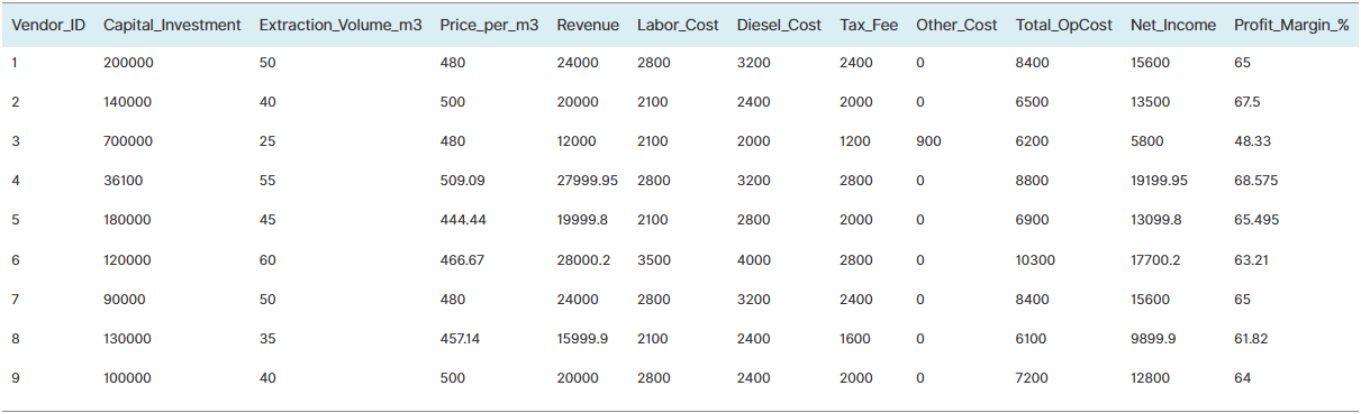
Analysis of the nine mechanised sand mining vendors shows that riverbed extraction along the Langkaih provides highly profitable but capital-intensive income streams. Daily extraction volumes range from 25 to 60 m³, with selling prices between ₹444–₹510 per m³, generating individual revenues from ₹12,000 to about ₹28,000 per day. The average daily revenue is ₹21,333, against a mean operating cost of ₹7,644, yielding a mean net income of approximately ₹13,689 per vendor per day. This corresponds to an average profit margin of 63.2%, indicating that a substantial share of gross earnings is retained as profit.
Across vendors, profit margins remain consistently high (≈48–69%), despite differences in extraction volume and capital investment (
Table 4). Vendors with moderate to high production (45–60 m³ day⁻¹) typically secure the highest absolute net incomes (>₹15,000 day⁻¹), confirming that scale of extraction is a primary driver of profitability. However, the vendor with the largest capital outlay (₹700,000) records one of the lowest margins (48.3%), suggesting diminishing returns to capital intensification and potential vulnerability to fluctuations in fuel price, demand, or regulatory constraints. This pattern implies that while mechanisation increases earning potential, it also embeds higher fixed and operating costs that can erode profit efficiency for heavily capitalised operators.
Table 4. Daily Profitability of Mechanised Sand Mining Vendors.
Overall, the livelihood model indicates that mechanised sand mining constitutes a high-return economic activity for participating vendors and likely underpins strong resistance to control measures. At the same time, the concentration of benefits among a small group of capitalised operators, combined with documented environmental degradation, underscores a policy dilemma: unregulated mechanical extraction is economically attractive yet environmentally unsustainable. These results support the need for regulatory frameworks that (i) cap extraction volumes, (ii) internalise environmental costs, and (iii) promote more equitable and sustainable livelihood options.
4.4. Sand Mining Vulnerability Index (SVMI): Manual vs Mechanical Sites
The SMVI clearly distinguishes the heightened risk associated with mechanical sand mining at Kanhmun-Down from the comparatively moderate risk at the manual Luimawi-Manual reach. Mechanical extraction exhibits a high composite Hazard Pressure (HP ≈ 68), driven by elevated truck intensity, off-season activity, turbidity exceedance and clustering of active sites. When combined with erodible sandy banks, discontinuous riparian vegetation and dense proximal infrastructure, this generates a high Environmental Sensitivity (ES ≈ 73) and Infrastructure Exposure (IE ≈ 70). Socio-economic dependence on the Langkaih for domestic use, fisheries and agriculture (SE ≈ 61) further amplifies potential impact. Although adaptive capacity is moderate (AC ≈ 47) due to partial piped supply and some alternative sources, it is insufficient to offset the concentrated pressures. The resulting Vulnerability Index (VI ≈ 64.3) and Risk Index (≈ 66.1) place Kanhmun-Down in the High risk class, identifying it as a critical sand-mining hotspot.
In contrast, the manual extraction reach at Luimawi-Manual records a substantially lower HP (≈ 43), reflecting fewer active sites and lower extraction intensity. ES is moderate (≈ 55) and IE is reduced (≈ 40) owing to more stable channel margins, better riparian cover and greater distance between extraction patches and critical infrastructure. Socio-economic exposure remains significant (SE ≈ 65), and adaptive capacity is relatively weak (AC ≈ 35), but the absence of heavy machinery and concentrated disturbance prevents the system from tipping into the high-risk domain. The derived VI (≈ 56.3) and Risk Index (≈ 49.6) classify Luimawi-Manual as Moderate risk (
Table 5). This indicates that, under current conditions, manual practices are more compatible with local geomorphic resilience and community water security than mechanised suction mining.
Table 5. Sand Mining Vulnerability Index (SMVI) for Mechanical and Manual Extraction Reaches of the Langkaih River.
Indicator / Index | Kanhmun-Down (Mechanical) | Luimawi-Manual (Manual) |
Hazard Pressure, HP | 68.0 | 43.0 |
Environmental Sensitivity, ES | 73.0 | 55.0 |
Socio-economic Exposure, SE | 61.0 | 65.0 |
Infrastructure Exposure, IE | 70.0 | 40.0 |
Adaptive Capacity, AC | 47.0 | 35.0 |
Vulnerability Index, VI | 64.3 | 56.3 |
SMVI RiskIndex | 66.1 | 49.6 |
Risk Class | High | Moderate |
Overall, the SMVI framework demonstrates that similar riverine settings can exhibit sharply different risk profiles depending on extraction modality. Mechanical operations (
Figure 2) align consistently with high HP–high VI combinations, justifying priority regulation, strict licensing, and targeted mitigation at Kanhmun-Down. Manual extraction (
Figure 3), while not impact-free, remains within a manageable vulnerability band, supporting a differentiated policy approach that curbs mechanised mining while permitting low-intensity manual practices subject to monitoring and enforceable safeguards.
Figure 2. Mechanical suction sand mining area, Site 1 (Kanhmun Village).
Figure 3. Manual extraction area, Site 2 (Luimawi Village).
4.5. Integrated Sustainability Index (ISI) for Manual Versus Mechanical Sand Mining
The Integrated Sustainability Index (ISI) clearly differentiates the sustainability performance of manual sand mining at Luimawi and mechanical suction mining at Kanhmun. Manual extraction shows no net deterioration in water quality between upstream and downstream, with negative WQIG (−29.4%) and TG (−37.2%) values translating into an environmental impact component . In contrast, mechanical mining records a sharp downstream increase in WQIG (+470.5%) and turbidity (+597.9%), yielding a very high impact score (), indicating substantial pressure on the Langkaih River’s assimilative capacity.
Economic returns, expressed as normalised income benefits, are comparable for both methods when benchmarked against the reference income of ₹20,000 day⁻¹. The observed mean net vendor income of ₹13,688 day⁻¹ for both cases corresponds to an economic benefit component . However, livelihood benefits strongly diverge. Manual mining is highly labour-intensive (assumed 20 workers per 100 m³), achieving the maximum livelihood component (), while mechanical extraction, with only about 5 workers per 100 m³, attains a much lower .
Combining these components with weights that prioritise environmental protection (
,
,
), the unscaled ISI for manual mining is 0.405, which rescales to ISI* = 0.905, classified as “High / Relatively Sustainable” (
Table 6). Mechanical suction mining yields an unscaled ISI of −0.229, corresponding to ISI* = 0.271, classified as “Low / Unsustainable”.
Table 6. Integrated Sustainability Index (ISI) for Manual and Mechanical Sand Mining along the Langkaih River.
Component | Manual (Luimawi) | Mechanical (Kanhmun) |
WQIG vs upstream (%) | −29.4 | +470.5 |
TG vs upstream (%) | −37.2 | +597.9 |
Environmental impact, E_m (0–1) | 0.000 | 0.969 |
Mean net income (₹/day) | 13,688 | 13,688 |
Economic benefit, B_eco (0–1) | 0.684 | 0.684 |
Workers per 100 m3 | 20 | 5 |
Livelihood benefit, B_liv (0–1) | 1.000 | 0.250 |
Raw ISI_m | 0.405 | −0.229 |
Scaled ISI* (0–1) | 0.905 | 0.271 |
Sustainability class | High | Low |
These results demonstrate that although both methods can generate comparable vendor-level profits, mechanical sand mining concentrates benefits among few operators while imposing disproportionately high ecological costs. Manual extraction at Luimawi, by contrast, distributes income across more workers and maintains downstream water quality within acceptable limits. The ISI therefore supports regulatory preference for controlled, small-scale manual extraction and stricter regulation or phase-down of mechanical suction mining along ecologically sensitive reaches of the Langkaih River.
5. Discussion
5.1. Differential Impacts of Mechanical and Manual Sand Mining on Water Quality
The combined physicochemical and biological evidence indicates acute ecological stress at the mechanised sand mining reach of the Langkaih River. At Site 1, Water Quality Index (WQI) values deteriorate from “Poor” upstream to “Unsuitable for drinking” at-site and downstream, driven primarily by extreme turbidity. This sharp, localised degradation is consistent with documented impacts of intensive instream sand extraction, where bed disturbance and entrainment of fine sediments alter substrate composition, disrupt flow hydraulics and degrade habitat quality for aquatic biota
| [5] | Ashraf, M. A., Maah, M. J., Yusoff, I., Wajid, A., & Mahmood, K. (2011). Sand mining effects, causes and concerns: A case study from Bestari Jaya, Selangor, Peninsular Malaysia. Scientific Research and Essays, 6(6), 1216-1231. |
| [47] | Pitchaiah, P. S. (2017). Anthropogenic impacts of sand mining in terms of geo-environmental issues of Kotaheru River Basin, Andhra Pradesh, India. International Journal of Geology, Earth and Environmental Sciences, 7(3), 19-27. |
[5, 47]
. In contrast, the manual site (Site 2) exhibits only transient deterioration at the extraction point with measurable downstream recovery, suggesting that low-intensity, non-mechanised operations exert comparatively limited and spatially constrained pressure on water quality and habitat structure.
Field photographs presented in
Figure 4 (A deceased aquatic animal was discovered at the sand mining site), showing dead or moribund fishes, crustaceans and amphibians within and adjacent to the mechanised extraction zone, provide direct biological corroboration of the WQI diagnosis. Elevated suspended sediment concentrations are known to clog and abrade gill tissues, impair gas exchange, and increase the energetic cost of respiration, leading to reduced growth and survival
. Experimental and empirical studies further demonstrate that prolonged exposure to high suspended solids causes behavioural impairment, including reduced swimming performance and altered escape responses, thereby increasing vulnerability to predation or capture
| [29] | Kumari, N., Pandey, S., & Kumar, G. (2024). Sand mining: A silent threat to the river ecosystem. In Rivers of India: Past, Present and Future (pp. 109-132). Cham: Springer International Publishing. |
| [40] | Naveen Saviour, M., & Stalin, P. (2012). Soil and sand mining: Causes, consequences and management. IOSR Journal of Pharmacy, 2(4), 1-6. |
| [41] | Newcombe, C. P., & MacDonald, D. D. (1991). Effects of suspended sediments on aquatic ecosystems. North American Journal of Fisheries Management, 11(1), 72-82. |
| [51] | Torres, A., Brandt, J., Lear, K., & Liu, J. (2017). A looming tragedy of the sand commons. Science, 357(6355), 970-971. |
[29, 40, 41, 51]
. Fine sediments can also transport sorbed contaminants and create hypoxic microhabitats, compounding stress on benthic and demersal organisms
| [28] | Kemp, P., Sear, D., Collins, A., Naden, P., & Jones, I. (2011). The impacts of fine sediment on riverine fish. Hydrological Processes, 25(11), 1800-1821. |
[28]
. These mechanisms are congruent with the observations at Site 1: extreme turbidity, severely degraded WQI classes, sluggish movement, easy capture, and visible mortality.
Figure 4. Deceased aquatic animals discovered at the Site 1 (Kanhmun Village) Manual sand mining site.
Recent syntheses emphasise that riverbed mining effects cascade through food webs, modifying energy pathways, recruitment success and functional diversity of fish and macroinvertebrates
| [17] | Damseth, S., Thakur, K., Kumar, R., Kumar, S., Mahajan, D., Kumari, H., & Sharma, A. K. (2024). Assessing the impacts of river bed mining on aquatic ecosystems. HydroResearch, 7, 122-130. https://doi.org/10.1016/j.hydres.2024.01.004 |
[17]
. Comparative evidence from other tropical systems similarly links unregulated sand mining hotspots with habitat simplification, fisheries decline and biodiversity loss
| [3] | Amoah, D. K., Awuah, E., Hodgson, I. O. A., Appiah-Brempong, M., & Nyarko, I. N. Y. (2024). The impact of river sand mining and waste management on the Volta Lake: A case study of Asutsuare. Scientific African, 26, e02359. https://doi.org/10.1016/j.sciaf.2024.e02359 |
| [53] | Wenger, A. S., Harvey, E., Wilson, S., Rawson, C., Newman, S. J., Clarke, K. R., & Evans, R. D. (2017). A critical analysis of the direct effects of dredging on fish. Fish and Fisheries, 18(5), 967-985. |
| [55] | Wilber, D. H., & Clarke, D. G. (2001). Biological effects of suspended sediments: A review of suspended sediment impacts on fish and shellfish with relation to dredging activities in estuaries. North American Journal of Fisheries Management, 21(4), 855-875. |
[3, 53, 55]
. Taken together, the Langkaih results indicate that mechanised suction mining at Site 1 operates beyond the river’s assimilative capacity, whereas controlled manual extraction at Site 2, under strict monitoring, may remain compatible with sustaining both local livelihoods and essential ecosystem functions. These findings substantiate the case for method-specific regulation, including stringent limits or prohibition of mechanised sand mining in ecologically sensitive reaches.
5.2. Contrasting Turbidity and WQIG Signatures under Mechanical vs Manual Extraction
The contrasting Water Quality Impact Gradient (WQIG) and Turbidity Response (TG) between the mechanical and manual sites demonstrate a clear method-specific water quality risk. The strong positive WQIG and TG values recorded downstream of mechanical extraction diagnose a persistent high-turbidity plume and compound degradation of overall potability, aligning with global evidence that intensive in-channel mining amplifies suspended sediment, bed instability, and cumulative physicochemical stress
| [31] | Koehnken, L., Rintoul, M. S., Goichot, M., Tickner, D., Loftus, A.-C., & Acreman, M. C. (2020). Impacts of riverine sand mining on freshwater ecosystems: A review of the scientific evidence and guidance for future research. River Research and Applications, 36(3), 362-370. |
| [47] | Pitchaiah, P. S. (2017). Anthropogenic impacts of sand mining in terms of geo-environmental issues of Kotaheru River Basin, Andhra Pradesh, India. International Journal of Geology, Earth and Environmental Sciences, 7(3), 19-27. |
[31, 47]
. In this context, the Langkaih mechanical reach behaves as a classic high-risk hotspot: concentrated suction and truck disturbance drive sharp longitudinal deterioration rather than localised, recoverable effects.
By contrast, the negative WQIG and TG values at the manual site indicate partial downstream recovery and containment of impacts within the river’s assimilative capacity. This pattern supports arguments that low-intensity, spatially dispersed manual extraction—when regulated—can be more compatible with fluvial resilience than mechanised operations, which often exceed geomorphic and ecological thresholds
| [38] | Mushonga, T. (2023). The dynamics of Zimbabwe's sand mining frontier. Centre for the Advancement of Scholarship, University of Pretoria. |
| [43] | Ojukwu, H. S., Umemezia, E. I., Agbadudu, J. E., & Azotani, F. C. (2022). Sand mining: Economic gains, environmental ethics, and policy implications. African Journal of Economics and Sustainable Development, 5(2), 119-138. |
[38, 43]
. The Langkaih results therefore empirically reinforce a differentiated regulatory approach: targeting mechanised mining as a priority pressure while treating small-scale manual extraction as conditionally permissible, subject to zoning, caps and monitoring.
Importantly, the gradient-based metrics used here respond to calls for quantitative, reach-specific indicators of sand mining impacts
| [47] | Pitchaiah, P. S. (2017). Anthropogenic impacts of sand mining in terms of geo-environmental issues of Kotaheru River Basin, Andhra Pradesh, India. International Journal of Geology, Earth and Environmental Sciences, 7(3), 19-27. |
[47]
. WQIG integrates cumulative shifts in key water quality parameters, while TG isolates the most immediate and visually manifest disturbance driver. Together, they provide a transparent, policy-relevant signal that can be directly linked to compliance thresholds, drinking-water risks, and ecosystem protection objectives. Their combined application shows that similar volumetric extraction, if mechanised and spatially clustered, generates disproportionate degradation relative to dispersed manual abstraction. These findings justify embedding WQIG and TG within broader sustainability and vulnerability frameworks (such as SMVI/ISI) to guide licensing, enforcement, and adaptive management, and highlight the need to phase down high-intensity mechanical mining in small, sensitive hill rivers such as the Langkaih.
5.3. Profitability, Dependence and Sustainability of Mechanised Sand Mining
The profitability analysis shows that mechanised sand mining along the Langkaih River yields consistently high returns, with daily profit margins typically exceeding 60% for most vendors. Such margins are substantially higher than typical rural wage opportunities, indicating a strong economic pull into mechanised extraction and a high degree of livelihood dependence. Similar concentration of benefits among capitalised operators is documented elsewhere, where sand miners and truck owners capture disproportionate gains while local residents bear environmental and social costs
| [4] | Asare, K. Y., Mensah, J. V., Agyenim-Boateng, J., Tenkorang, E. Y., & Hemmler, K. S. (2024). Economic and socio-ecological effects of sand mining on livelihoods in the Gomoa East District and Ga South Municipality, Ghana. The Extractive Industries and Society, 19, 101487.
https://doi.org/10.1016/j.exis.2024.101487 |
| [23] | Hilson, G. (2012). Poverty traps in small-scale mining communities: The case of sub-Saharan Africa. The Extractive Industries and Society, 1(2), 257-263. |
[4, 23]
.
However, the Langkaih results also reveal important vulnerability signals. The most heavily capitalised operator, despite large investment, records the lowest profit margin, suggesting diminishing returns to capital intensification and heightened exposure to fluctuations in fuel prices, demand, or regulatory changes. This pattern mirrors broader evidence that mechanised resource extraction can create “profit–risk traps,” in which high fixed costs and volatile operating conditions undermine long-term livelihood security
| [23] | Hilson, G. (2012). Poverty traps in small-scale mining communities: The case of sub-Saharan Africa. The Extractive Industries and Society, 1(2), 257-263. |
[23]
. If enforcement tightens or environmental degradation constrains production, these vendors may face rapid income shocks, while having few incentives to internalise ecological costs.
From a sustainability perspective, the very profitability of mechanised extraction intensifies pressure on the river system. Global reviews show that riverine sand mining at industrial or mechanised scales is strongly associated with channel incision, habitat loss, turbidity increase, and declining ecosystem services
| [30] | Kjelland, M. E., Woodley, C. M., Swannack, T. M., & Smith, D. L. (2015). A review of the potential effects of suspended sediment on fishes. Environment Systems and Decisions, 35(3), 334-350. |
| [47] | Pitchaiah, P. S. (2017). Anthropogenic impacts of sand mining in terms of geo-environmental issues of Kotaheru River Basin, Andhra Pradesh, India. International Journal of Geology, Earth and Environmental Sciences, 7(3), 19-27. |
[30, 47]
. The Langkaih WQIG/TG results—extreme downstream deterioration at the mechanised site—align with this evidence, implying that current income levels are achieved by externalising substantial environmental costs.
| [4] | Asare, K. Y., Mensah, J. V., Agyenim-Boateng, J., Tenkorang, E. Y., & Hemmler, K. S. (2024). Economic and socio-ecological effects of sand mining on livelihoods in the Gomoa East District and Ga South Municipality, Ghana. The Extractive Industries and Society, 19, 101487.
https://doi.org/10.1016/j.exis.2024.101487 |
[4]
similarly report that while sand miners profit, surrounding communities experience livelihood losses and degraded commons.
Consequently, the findings support a policy stance that recognises mechanised sand mining as both economically attractive and environmentally unsustainable. Regulation should (i) cap extraction volumes and enforce “polluter pays” principles, (ii) prioritise licensing frameworks that discourage excessive mechanisation, and (iii) invest in alternative and transitional livelihoods so that curbing harmful practices does not exacerbate poverty or create new vulnerability traps for dependent households.
5.4. Social–ecological vulnerability: Evidence from SMVI
The SMVI results highlight a pronounced method-specific divergence in sand-mining risk along the Langkaih River. Mechanical extraction at Kanhmun-Down exhibits a High Risk Index, combining intense hazard pressure with elevated environmental sensitivity, socio-economic exposure and infrastructure proximity, only partially moderated by adaptive capacity. By contrast, the manual Luimawi reach falls within a Moderate risk band, reflecting lower pressure and infrastructure exposure under similar community dependence. This pattern is consistent with broader evidence that concentrated, mechanised in-channel mining accelerates bed degradation, turbidity, bank erosion and habitat loss, frequently pushing systems beyond morphological resilience thresholds
| [31] | Koehnken, L., Rintoul, M. S., Goichot, M., Tickner, D., Loftus, A.-C., & Acreman, M. C. (2020). Impacts of riverine sand mining on freshwater ecosystems: A review of the scientific evidence and guidance for future research. River Research and Applications, 36(3), 362-370. |
| [43] | Ojukwu, H. S., Umemezia, E. I., Agbadudu, J. E., & Azotani, F. C. (2022). Sand mining: Economic gains, environmental ethics, and policy implications. African Journal of Economics and Sustainable Development, 5(2), 119-138. |
| [47] | Pitchaiah, P. S. (2017). Anthropogenic impacts of sand mining in terms of geo-environmental issues of Kotaheru River Basin, Andhra Pradesh, India. International Journal of Geology, Earth and Environmental Sciences, 7(3), 19-27. |
[31, 43, 47]
.
The SMVI also clarifies that risk is not solely a function of extraction volume but of where and how extraction occurs. High scores for HP, ES and IE at the mechanical site indicate cumulative impacts from suction dredging, bar incision and truck traffic in close proximity to settlements (
Figure 5), intakes and public assets. Similar hotspot conditions are widely reported where regulatory controls are weak and mechanised operations are spatially clustered
| [13] | Botutihe, N. M., Ulfiana, A., Haris, A., & Mohi, A. (2025). Environmental and socio-economic impacts of river sand and gravel mining: A review. Asian Journal of Environment & Ecology, 24(16), 90-103. |
| [47] | Pitchaiah, P. S. (2017). Anthropogenic impacts of sand mining in terms of geo-environmental issues of Kotaheru River Basin, Andhra Pradesh, India. International Journal of Geology, Earth and Environmental Sciences, 7(3), 19-27. |
[13, 47]
. At Luimawi, manual extraction is dispersed, uses simple tools and is physically separated from critical infrastructure, allowing the river’s assimilative capacity and riparian buffering to limit the propagation of impacts. Under the adopted weighting scheme, this configuration yields substantially lower composite risk despite comparable socio-economic dependence, supporting policy differentiation between labour-based and capital-intensive mining.
Figure 5. Heavy trucks transporting river sand from the mechanised mining site at Kanhmun- along village roads in close proximity to settlements along the Langkaih River.
Methodologically, SMVI demonstrates how integrating hazard, vulnerability and adaptive capacity into a transparent 0–100 index can operationalise sustainability principles for river sand mining. The index responds to calls for quantitative, site-specific tools to guide licensing, zoning and enforcement
| [20] | Gopal, T. V. R. (2025). River sand and gravel mining: Striking a balance between ecology and economy. International Journal of Environment and Ecology Studies, 5(1), 1-16. |
| [47] | Pitchaiah, P. S. (2017). Anthropogenic impacts of sand mining in terms of geo-environmental issues of Kotaheru River Basin, Andhra Pradesh, India. International Journal of Geology, Earth and Environmental Sciences, 7(3), 19-27. |
[20, 47]
. In practice, the Langkaih application suggests three implications: (i) mechanised reaches such as Kanhmun-Down should be prioritised for stringent limits, phased reduction or closure; (ii) manual extraction may be maintained under capped effort, spatial setbacks and continuous monitoring; and (iii) improvements in piped supply, alternative water sources, governance and livelihood diversification would directly reduce SMVI scores, providing a concrete pathway for risk mitigation and more equitable benefit-sharing.
5.5. Integrating Environment–Livelihood Trade-Offs: Insights from ISI
The Integrated Sustainability Index (ISI) developed for sand mining along the Langkaih River demonstrates that traditional manual extraction practices retain a comparatively balanced sustainability profile, whereas mechanised mining is clearly unsustainable once environmental, social and economic dimensions are integrated. This pattern is consistent with global evidence that low-intensity, labour-based extraction generates local livelihoods but becomes critically damaging when scaled up through mechanised dredging without safeguards, accelerating channel incision, bank erosion and habitat loss
| [30] | Kjelland, M. E., Woodley, C. M., Swannack, T. M., & Smith, D. L. (2015). A review of the potential effects of suspended sediment on fishes. Environment Systems and Decisions, 35(3), 334-350. |
| [47] | Pitchaiah, P. S. (2017). Anthropogenic impacts of sand mining in terms of geo-environmental issues of Kotaheru River Basin, Andhra Pradesh, India. International Journal of Geology, Earth and Environmental Sciences, 7(3), 19-27. |
[30, 47]
.
The ISI framework, grounded in a weighted multi-criteria approach, aligns with recent triple-bottom-line assessments that integrate environmental, economic and social indicators into composite decision-support tools
| [35] | Mia, M. M. M., Karikar, B. A. K. B. A., Mohibul, S. M. S., & Ali, M. I. A. M. I. (2024). Environmental and socio-economic impacts of river sand and gravel mining: A review. Research Square (Preprint). |
[35]
. By combining water quality, geomorphic stability, biodiversity, occupational safety, livelihood dependence and regulatory compliance, the present analysis more clearly distinguishes context-appropriate artisanal mining from high-risk mechanised operations than conventional single-parameter evaluations. Open-access applications of geospatial and participatory monitoring similarly show that unregulated mechanised sand extraction (
Figure 6) drives disproportionate bankline retreat and channel instability
| [7] | Bayazidy, S., Kamali, M., & Arefinia, P. (2024). [Confirm exact title on suspended sediment and fish biodiversity]. Water. |
[7]
, while empirical socio-economic assessments highlight how intensified extraction on floodplains exacerbates exposure of households, farmland and infrastructure to erosion and flooding
| [6] | Atser, T. I., Dam, D. P., Onah, M. A., & Mage, J. O. (2025). Socio-economic and environmental impact of sand mining on the floodplains of River Benue, Makurdi Town, Benue State, Nigeria. International Journal of Research and Innovation in Applied Science, 10(4), 310-326.
https://doi.org/10.51584/ijrias.2025.10040025 |
[6]
.
Figure 6. Mechanized Sand mine Stock area.
Importantly, the moderate ISI score for manual mining should not be misconstrued as a license for unrestricted removal. Global reviews emphasise that sustainability thresholds are rapidly crossed once extraction exceeds natural replenishment or encroaches upon sensitive hydraulic and ecological zones
| [30] | Kjelland, M. E., Woodley, C. M., Swannack, T. M., & Smith, D. L. (2015). A review of the potential effects of suspended sediment on fishes. Environment Systems and Decisions, 35(3), 334-350. |
| [46] | Park, E. (2024). Sand mining in the Mekong Delta: Extent and compounded impacts. Science of the Total Environment, 924, 171620. |
[30, 46]
. The Langkaih findings therefore support a precautionary governance model: licensing only controlled, non-mechanised extraction; enforcing exclusion zones near banks, deep pools and water intakes; periodic ISI-based compliance audits; and mandatory site rehabilitation. Embedding the ISI within regulatory and community-based monitoring frameworks would enable adaptive limits based on observed river response, strengthen alignment with national sand-mining guidelines, and offer a transferable tool for other Himalayan and Northeast Indian rivers confronting comparable extraction pressures.
5.6. Management Implications and Recommendations
The findings clearly indicate that mechanised in-stream sand mining in small hill rivers such as the Langkaih should be classified as a high-risk and generally unacceptable practice, given its disproportionate impacts on water quality, channel stability, and bank integrity over short spatial scales
| [21] | Hackney, C. R., Darby, S. E., Parsons, D. R., et al. (2020). River bank instability from unsustainable sand mining in the lower Mekong River. Nature Sustainability, 3(3), 217-225. https://doi.org/10.1038/s41893-019-0455-3 |
| [31] | Koehnken, L., Rintoul, M. S., Goichot, M., Tickner, D., Loftus, A.-C., & Acreman, M. C. (2020). Impacts of riverine sand mining on freshwater ecosystems: A review of the scientific evidence and guidance for future research. River Research and Applications, 36(3), 362-370. |
| [32] | Kondolf, G. M. (1994). Geomorphic and environmental effects of instream gravel mining. Landscape and Urban Planning, 28(2-3), 225-243. |
| [45] | Padmalal, D., Maya, K., Sreebha, S., & Sreeja, R. (2008). Environmental effects of river sand mining: A case from the river catchments of Vembanad Lake, southwest coast of India. Environmental Geology, 54(4), 879-889. |
| [47] | Pitchaiah, P. S. (2017). Anthropogenic impacts of sand mining in terms of geo-environmental issues of Kotaheru River Basin, Andhra Pradesh, India. International Journal of Geology, Earth and Environmental Sciences, 7(3), 19-27. |
[21, 31, 32, 45, 47]
. Evidence from comparable systems shows that intensive mechanised extraction systematically exceeds natural replenishment, promotes incision and bank erosion, and undermines infrastructure and ecological functions, reinforcing the need for a precautionary regulatory stance in steep, sediment-limited hill catchments
| [8] | Bendixen, M., Best, J., Hackney, C. R., & Iversen, L. L. (2021). Time is running out for sand. One Earth, 4(5), 616-628.
https://doi.org/10.1016/j.oneear.2021.04.011 |
| [30] | Kjelland, M. E., Woodley, C. M., Swannack, T. M., & Smith, D. L. (2015). A review of the potential effects of suspended sediment on fishes. Environment Systems and Decisions, 35(3), 334-350. |
| [52] | Uddin, M. G., Nash, S., & Olbert, A. I. (2021). A review of water quality index models and their use for assessing surface water quality. Ecological Indicators, 122, 107218. |
[8, 30, 52]
. In contrast, small-scale manual extraction may be considered only as a conditionally permissible activity, restricted to low-intensity operations sited beyond ecologically sensitive reaches, water intakes, and unstable banks, and contingent on demonstrable compliance with science-based thresholds derived from WQIG, turbidity gradients, SMVI, and ISI. Embedding these indices into licensing criteria, environmental clearance conditions, and periodic third-party audits would operationalise a defensible distinction between acceptable and harmful operations, consistent with global best practice on sediment-budget-based regulation
| [17] | Damseth, S., Thakur, K., Kumar, R., Kumar, S., Mahajan, D., Kumari, H., & Sharma, A. K. (2024). Assessing the impacts of river bed mining on aquatic ecosystems. HydroResearch, 7, 122-130. https://doi.org/10.1016/j.hydres.2024.01.004 |
| [44] | Padmalal, D., & Maya, K. (2014). Sand mining: Environmental impacts and selected case studies. Springer. |
| [47] | Pitchaiah, P. S. (2017). Anthropogenic impacts of sand mining in terms of geo-environmental issues of Kotaheru River Basin, Andhra Pradesh, India. International Journal of Geology, Earth and Environmental Sciences, 7(3), 19-27. |
[17, 44, 47]
. For hill rivers of Northeast India and similar montane basins, the proposed indicator framework is readily transferable and can guide riverbed mining caps, adaptive moratoria, and targeted restoration of degraded reaches, while recognising legitimate livelihood needs. Used in conjunction with cumulative impact assessment and catchment-scale sediment budgeting, this framework offers regulators and river managers a practical toolset to reconcile local construction demand with the long-term integrity of fragile fluvial ecosystems
| [8] | Bendixen, M., Best, J., Hackney, C. R., & Iversen, L. L. (2021). Time is running out for sand. One Earth, 4(5), 616-628.
https://doi.org/10.1016/j.oneear.2021.04.011 |
| [21] | Hackney, C. R., Darby, S. E., Parsons, D. R., et al. (2020). River bank instability from unsustainable sand mining in the lower Mekong River. Nature Sustainability, 3(3), 217-225. https://doi.org/10.1038/s41893-019-0455-3 |
| [30] | Kjelland, M. E., Woodley, C. M., Swannack, T. M., & Smith, D. L. (2015). A review of the potential effects of suspended sediment on fishes. Environment Systems and Decisions, 35(3), 334-350. |
| [47] | Pitchaiah, P. S. (2017). Anthropogenic impacts of sand mining in terms of geo-environmental issues of Kotaheru River Basin, Andhra Pradesh, India. International Journal of Geology, Earth and Environmental Sciences, 7(3), 19-27. |
[8, 21, 30, 47]
.
6. Conclusion
This study reveals that extraction method, operational intensity, and local vulnerability context fundamentally determine the environmental and socio-economic risks of sand mining in steep hill river systems. Along the Langkaih River, mechanised suction mining at Kanhmun caused severe downstream water quality degradation—evidenced by a 470% increase in WQI and 598% turbidity spike—accompanied by visible aquatic mortality and high Sand Mining Vulnerability Index (SMVI) scores. In contrast, controlled manual extraction at Luimawi induced only localized, partially reversible impacts, retained WQI within “Poor–Very Poor” ranges, and achieved broader employment distribution under moderate risk classification.
By integrating gradient-based indicators (WQIG, TG), a profitability model, SMVI, and an Integrated Sustainability Index (ISI), the study presents a transparent, reproducible framework for method-specific sand mining governance. This framework (i) Identifies mechanised reaches as priority zones for stringent regulation, phased reduction, or transition support; (ii) Recommends conditional licensing of low-intensity manual mining, subject to spatial buffers, extraction caps, and regular compliance audits; (iii) Highlights how investments in piped water supply, institutional strengthening, and livelihood diversification can directly lower vulnerability and enhance resilience.
The findings position the Langkaih River as an evidence-based testbed for adaptive sand mining regulation in data-limited, ecologically sensitive hill environments. The composite indicator framework developed here is transferable to similar Himalayan and tropical river systems, offering a policy tool to balance construction needs with environmental integrity and socio-economic equity. Future work should expand the temporal coverage across seasons and apply this framework in varied geomorphic contexts to refine sustainability thresholds and improve replicability.
Abbreviations
AC | Adaptive Capacity |
APHA | American Public Health Association |
BIS | Bureau of Indian Standards |
CSI | City Sustainability Index |
EC | Electrical Conductivity |
ES | Environmental Sensitivity |
HP | Hazard Pressure |
IE | Infrastructure Exposure |
IOP | Institute of Physics (IOP Conference Series) |
IOSR | International Organization of Scientific Research |
IS | Indian Standard (e.g. IS 10500:2012) |
ISI | Integrated Sustainability Index |
M-sand | Manufactured Sand |
NTU | Nephelometric Turbidity Unit |
OECD | Organisation for Economic Co-operation and Development |
ORCID | Open Researcher and Contributor ID |
SABS | Suspended and Bedded Sediment |
SE | Socio-economic Exposure |
SMVI | Sand Mining Vulnerability Index |
TDS | Total Dissolved Solids |
TG | Turbidity Gradient (Keep This Same Meaning Everywhere) |
USA | United States of America |
VI | Vulnerability Index |
WQI | Water Quality Index |
WQIG | Water Quality Impact Gradient |
Author Contributions
Renthlei Zonunsanga: Conceptualization, Data curation, Formal Analysis, Investigation
Benjamin Lalengliana Sailo: Conceptualization, Methodology, Resources, Supervision, Writing – original draft, Writing – review & editing
Laldinpuia: Investigation, Data curation, Formal Analysis, Writing – original draft
Michael Lalnunpuia: Investigation, Visualization, Writing – review & editing
Ralte Lalhmangaihzuala: Formal Analysis, Software, Validation
Lalrinawma: Data curation, Investigation
Jonathan Lalrinawma: Resources, Validation, Writing – review & editing
Rosiamliana: Project administration, Writing – review & editing
Funding
This research did not receive any specific grant from funding agencies in the public, commercial, or not-for-profit sectors.
Data Availability Statement
The data that support the findings of this study are available from the corresponding author upon reasonable request.
Conflicts of Interest
The authors state that they have no conflicts of interest, financial or personal, that could have influenced the content of this publication.
References
| [1] |
Abdulazeez, A. (2016). A review on the impact of river and inland sand mining on Nigerian river basins. Research gate.
|
| [2] |
American Public Health Association, American Water Works Association, & Water Environment Federation. (2017). Standard methods for the examination of water and wastewater (23rd ed.). APHA Press.
|
| [3] |
Amoah, D. K., Awuah, E., Hodgson, I. O. A., Appiah-Brempong, M., & Nyarko, I. N. Y. (2024). The impact of river sand mining and waste management on the Volta Lake: A case study of Asutsuare. Scientific African, 26, e02359.
https://doi.org/10.1016/j.sciaf.2024.e02359
|
| [4] |
Asare, K. Y., Mensah, J. V., Agyenim-Boateng, J., Tenkorang, E. Y., & Hemmler, K. S. (2024). Economic and socio-ecological effects of sand mining on livelihoods in the Gomoa East District and Ga South Municipality, Ghana. The Extractive Industries and Society, 19, 101487.
https://doi.org/10.1016/j.exis.2024.101487
|
| [5] |
Ashraf, M. A., Maah, M. J., Yusoff, I., Wajid, A., & Mahmood, K. (2011). Sand mining effects, causes and concerns: A case study from Bestari Jaya, Selangor, Peninsular Malaysia. Scientific Research and Essays, 6(6), 1216-1231.
|
| [6] |
Atser, T. I., Dam, D. P., Onah, M. A., & Mage, J. O. (2025). Socio-economic and environmental impact of sand mining on the floodplains of River Benue, Makurdi Town, Benue State, Nigeria. International Journal of Research and Innovation in Applied Science, 10(4), 310-326.
https://doi.org/10.51584/ijrias.2025.10040025
|
| [7] |
Bayazidy, S., Kamali, M., & Arefinia, P. (2024). [Confirm exact title on suspended sediment and fish biodiversity]. Water.
|
| [8] |
Bendixen, M., Best, J., Hackney, C. R., & Iversen, L. L. (2021). Time is running out for sand. One Earth, 4(5), 616-628.
https://doi.org/10.1016/j.oneear.2021.04.011
|
| [9] |
Berry, W., Newcombe, C. P., & Clarke, L. (2003). The biological effects of suspended and bedded sediment (SABS) in aquatic systems: A review. U.S. Environmental Protection Agency.
|
| [10] |
Bhatawdekar, R. M., Singh, T. N., Mohamad, E. T., Armaghani, D. J., & Hasbollah, D. Z. B. A. (2021). River sand mining vis-à-vis manufactured sand for sustainability. In Lecture Notes in Civil Engineering (Vol. 109). Springer.
|
| [11] |
Bhattacharya, R. K., Das Chatterjee, N., & Dolui, G. (2019). Consequences of sand mining on water quality and instream biota in alluvial stream. Sustainable Water Resources Management, 5, 1815-1832.
https://doi.org/10.1007/s40899-017-0222-7
|
| [12] |
Bilotta, G. S., & Brazier, R. E. (2008). Understanding the influence of suspended solids on water quality and aquatic biota. Water Research, 42(12), 2849-2861.
https://doi.org/10.1016/j.watres.2008.03.018
|
| [13] |
Botutihe, N. M., Ulfiana, A., Haris, A., & Mohi, A. (2025). Environmental and socio-economic impacts of river sand and gravel mining: A review. Asian Journal of Environment & Ecology, 24(16), 90-103.
|
| [14] |
Brown, R. M., McClelland, N. I., Deininger, R. A., & Tozer, R. G. (1970). A water quality index—Do we dare? Water and Sewage Works, 117(10), 339-343.
|
| [15] |
Bureau of Indian Standards. (2012). IS 10500: Drinking water—Specification. BIS.
|
| [16] |
Chidiac, S., El Najjar, P., Ouaini, N., El Rayess, Y., & El Azzi, D. (2023). A comprehensive review of water quality indices: History, models, attempts and perspectives. Reviews in Environmental Science and Bio/Technology, 22, 349-395.
https://doi.org/10.1007/s11157-023-09650-7
|
| [17] |
Damseth, S., Thakur, K., Kumar, R., Kumar, S., Mahajan, D., Kumari, H., & Sharma, A. K. (2024). Assessing the impacts of river bed mining on aquatic ecosystems. HydroResearch, 7, 122-130.
https://doi.org/10.1016/j.hydres.2024.01.004
|
| [18] |
Doloksaribu, L., Syahrul, S., & Zulfikar, L. (2020). Evaluation of the impact of sand mining along Sadang River on river morphology. IOP Conference Series: Earth and Environmental Science, 575, 012043.
https://doi.org/10.1088/1755-1315/575/1/012043
|
| [19] |
Gómez-Limón, J. A., & Sanchez-Fernandez, G. (2010). Empirical evaluation of agricultural sustainability using composite indicators. Ecological Economics, 69(5), 1062-1075.
|
| [20] |
Gopal, T. V. R. (2025). River sand and gravel mining: Striking a balance between ecology and economy. International Journal of Environment and Ecology Studies, 5(1), 1-16.
|
| [21] |
Hackney, C. R., Darby, S. E., Parsons, D. R., et al. (2020). River bank instability from unsustainable sand mining in the lower Mekong River. Nature Sustainability, 3(3), 217-225.
https://doi.org/10.1038/s41893-019-0455-3
|
| [22] |
Han, Y., Li, Q., Wang, L., Zhang, Y., & Lu, Y. (2023). Effects of dredging and sand mining on fish communities and habitats: A global synthesis. Proceedings of the Royal Society B, 290.
|
| [23] |
Hilson, G. (2012). Poverty traps in small-scale mining communities: The case of sub-Saharan Africa. The Extractive Industries and Society, 1(2), 257-263.
|
| [24] |
Hübler, M., & Pothen, F. (2021). Global sand demand, supply and environmental impacts. Resources Policy, 74, 102322.
|
| [25] |
Iversen, L. L., et al. (2024). Environmental and socio-economic impacts of river sand mining: A quick scoping review. [Report].
|
| [26] |
Jain, P., & Dohare, D. (2022). Water quality index and its application: A review. Water Practice and Technology, 17(8), 1822-1836.
|
| [27] |
Johnbull, S. W., & Brown, I. (2017). Socio-economic consequences of sand mining along Victory River in Port Harcourt, Nigeria. Asian Journal of Environment & Ecology, 3(2), 1-15.
|
| [28] |
Kemp, P., Sear, D., Collins, A., Naden, P., & Jones, I. (2011). The impacts of fine sediment on riverine fish. Hydrological Processes, 25(11), 1800-1821.
|
| [29] |
Kumari, N., Pandey, S., & Kumar, G. (2024). Sand mining: A silent threat to the river ecosystem. In Rivers of India: Past, Present and Future (pp. 109-132). Cham: Springer International Publishing.
|
| [30] |
Kjelland, M. E., Woodley, C. M., Swannack, T. M., & Smith, D. L. (2015). A review of the potential effects of suspended sediment on fishes. Environment Systems and Decisions, 35(3), 334-350.
|
| [31] |
Koehnken, L., Rintoul, M. S., Goichot, M., Tickner, D., Loftus, A.-C., & Acreman, M. C. (2020). Impacts of riverine sand mining on freshwater ecosystems: A review of the scientific evidence and guidance for future research. River Research and Applications, 36(3), 362-370.
|
| [32] |
Kondolf, G. M. (1994). Geomorphic and environmental effects of instream gravel mining. Landscape and Urban Planning, 28(2-3), 225-243.
|
| [33] |
Kondolf, G. M. (1997). Hungry water: Effects of dams and gravel mining on river channels. Environmental Management, 21(4), 533-551.
|
| [34] |
Kondolf, G. M., Smeltzer, M., & Kimball, L. (2002). Freshwater gravel mining and dredging issues. Center for Environmental Design Research.
|
| [35] |
Mia, M. M. M., Karikar, B. A. K. B. A., Mohibul, S. M. S., & Ali, M. I. A. M. I. (2024). Environmental and socio-economic impacts of river sand and gravel mining: A review. Research Square (Preprint).
|
| [36] |
Mishra, A., Das, S. K., & Reddy, K. R. (2023). Life cycle triple bottom line sustainability assessment of coal mine overburden sand versus river sand. Resources Policy, 86, 104140.
|
| [37] |
Mori, K., & Christodoulou, A. (2012). Review of sustainability indices and indicators: Towards a new City Sustainability Index (CSI). Environmental Impact Assessment Review, 32(1), 94-106.
|
| [38] |
Mushonga, T. (2023). The dynamics of Zimbabwe's sand mining frontier. Centre for the Advancement of Scholarship, University of Pretoria.
|
| [39] |
Naveen Saviour, M. (2012). Environmental impact of soil and sand mining: A review. International Journal of Science, Environment and Technology, 1(3), 125-134.
|
| [40] |
Naveen Saviour, M., & Stalin, P. (2012). Soil and sand mining: Causes, consequences and management. IOSR Journal of Pharmacy, 2(4), 1-6.
|
| [41] |
Newcombe, C. P., & MacDonald, D. D. (1991). Effects of suspended sediments on aquatic ecosystems. North American Journal of Fisheries Management, 11(1), 72-82.
|
| [42] |
Organisation for Economic Co-operation and Development. (2008). Handbook on constructing composite indicators: Methodology and user guide. OECD.
|
| [43] |
Ojukwu, H. S., Umemezia, E. I., Agbadudu, J. E., & Azotani, F. C. (2022). Sand mining: Economic gains, environmental ethics, and policy implications. African Journal of Economics and Sustainable Development, 5(2), 119-138.
|
| [44] |
Padmalal, D., & Maya, K. (2014). Sand mining: Environmental impacts and selected case studies. Springer.
|
| [45] |
Padmalal, D., Maya, K., Sreebha, S., & Sreeja, R. (2008). Environmental effects of river sand mining: A case from the river catchments of Vembanad Lake, southwest coast of India. Environmental Geology, 54(4), 879-889.
|
| [46] |
Park, E. (2024). Sand mining in the Mekong Delta: Extent and compounded impacts. Science of the Total Environment, 924, 171620.
|
| [47] |
Pitchaiah, P. S. (2017). Anthropogenic impacts of sand mining in terms of geo-environmental issues of Kotaheru River Basin, Andhra Pradesh, India. International Journal of Geology, Earth and Environmental Sciences, 7(3), 19-27.
|
| [48] |
Rentier, E. S., & Cammeraat, L. H. (2022). The environmental impacts of river sand mining. Science of The Total Environment, 838(1), 155877.
|
| [49] |
Sreebha, S., & Padmalal, D. (2011). Environmental impact assessment of sand mining from small catchment rivers in the southwestern coast of India: A case study. Environmental Management, 47(1), 130-140.
|
| [50] |
Thornton, E. B., Sallenger, A., Conforto Sesto, J., Egley, L., McGee, T., & Parsons, R. (2006). Sand mining impacts on long-term dune erosion in southern Monterey Bay. Marine Geology, 229(1-2), 45-58.
|
| [51] |
Torres, A., Brandt, J., Lear, K., & Liu, J. (2017). A looming tragedy of the sand commons. Science, 357(6355), 970-971.
|
| [52] |
Uddin, M. G., Nash, S., & Olbert, A. I. (2021). A review of water quality index models and their use for assessing surface water quality. Ecological Indicators, 122, 107218.
|
| [53] |
Wenger, A. S., Harvey, E., Wilson, S., Rawson, C., Newman, S. J., Clarke, K. R., & Evans, R. D. (2017). A critical analysis of the direct effects of dredging on fish. Fish and Fisheries, 18(5), 967-985.
|
| [54] |
Wiejaczka, Ł., Tamang, L., Piróg, D., & Prokop, P. (2018). Socio-environmental issues of river bed material extraction in the Himalayan piedmont (India). Environmental Earth Sciences, 77, 718.
|
| [55] |
Wilber, D. H., & Clarke, D. G. (2001). Biological effects of suspended sediments: A review of suspended sediment impacts on fish and shellfish with relation to dredging activities in estuaries. North American Journal of Fisheries Management, 21(4), 855-875.
|
Cite This Article
-
APA Style
Zonunsanga, R., Sailo, B. L., Laldinpuia, Lalnunpuia, M., Lalhmangaihzuala, R., et al. (2026). Composite Assessment of Sand Mining Impacts in a Hill River: The Langkaih River, Northeast India. International Journal of Environmental Monitoring and Analysis, 14(2), 72-88. https://doi.org/10.11648/j.ijema.20261402.12
 Copy
|
Copy
|
 Download
ACS Style
Zonunsanga, R.; Sailo, B. L.; Laldinpuia; Lalnunpuia, M.; Lalhmangaihzuala, R., et al. Composite Assessment of Sand Mining Impacts in a Hill River: The Langkaih River, Northeast India. Int. J. Environ. Monit. Anal. 2026, 14(2), 72-88. doi: 10.11648/j.ijema.20261402.12
Copy
|
Download
AMA Style
Zonunsanga R, Sailo BL, Laldinpuia, Lalnunpuia M, Lalhmangaihzuala R, et al. Composite Assessment of Sand Mining Impacts in a Hill River: The Langkaih River, Northeast India. Int J Environ Monit Anal. 2026;14(2):72-88. doi: 10.11648/j.ijema.20261402.12
Copy
|
Download
-
@article{10.11648/j.ijema.20261402.12,
  author = {Renthlei Zonunsanga and Benjamin Lalengliana Sailo and Laldinpuia and Michael Lalnunpuia and Ralte Lalhmangaihzuala and Lalrinawma and Jonathan Lalrinawma and Rosiamliana},
  title = {Composite Assessment of Sand Mining Impacts in a Hill River: The Langkaih River, Northeast India},
  journal = {International Journal of Environmental Monitoring and Analysis},
  volume = {14},
  number = {2},
  pages = {72-88},
  doi = {10.11648/j.ijema.20261402.12},
  url = {https://doi.org/10.11648/j.ijema.20261402.12},
  eprint = {https://article.sciencepublishinggroup.com/pdf/10.11648.j.ijema.20261402.12},
  abstract = {Sand mining in small, steep hill rivers remains poorly quantified despite rising global concern over aggregate-driven ecological degradation. This study develops an integrated, indicator-based framework to evaluate the environmental and socio-economic impacts of manual and mechanical sand mining along the Langkaih River, Mizoram, Northeast India—a transboundary hill river recently subjected to a ban on mechanized extraction. Water quality was assessed at upstream, active, and downstream sites using the Water Quality Index (WQI) and a novel Water Quality Impact Gradient (WQIG), combined with turbidity analysis and livelihood surveys. These datasets informed two composite indicators—the Sand Mining Vulnerability Index (SMVI) and an Integrated Sustainability Index (ISI)—linking environmental pressure, socio-economic dependence, and adaptive capacity. Results show that mechanical suction mining generated extreme turbidity plumes and WQI deterioration from “Poor” to “Unsuitable for drinking,” with a 470% WQIG increase and high vulnerability (SMVI ≈ 64). Manual extraction caused moderate, reversible impacts (WQIG = −29%), higher employment intensity, and greater overall sustainability (ISI = 0.91 vs. 0.27). The framework transparently differentiates mining methods by environmental and livelihood performance, supporting evidence-based regulation in data-limited hill systems. The findings provide a transferable model for sustainable sand governance to protect drinking-water security and riverine ecosystem health across Himalayan and tropical basins.},
 year = {2026}
}
Copy
|
Download
-
TY  - JOUR
T1  - Composite Assessment of Sand Mining Impacts in a Hill River: The Langkaih River, Northeast India
AU  - Renthlei Zonunsanga
AU  - Benjamin Lalengliana Sailo
AU  - Laldinpuia
AU  - Michael Lalnunpuia
AU  - Ralte Lalhmangaihzuala
AU  - Lalrinawma
AU  - Jonathan Lalrinawma
AU  - Rosiamliana
Y1  - 2026/03/10
PY  - 2026
N1  - https://doi.org/10.11648/j.ijema.20261402.12
DO  - 10.11648/j.ijema.20261402.12
T2  - International Journal of Environmental Monitoring and Analysis
JF  - International Journal of Environmental Monitoring and Analysis
JO  - International Journal of Environmental Monitoring and Analysis
SP  - 72
EP  - 88
PB  - Science Publishing Group
SN  - 2328-7667
UR  - https://doi.org/10.11648/j.ijema.20261402.12
AB  - Sand mining in small, steep hill rivers remains poorly quantified despite rising global concern over aggregate-driven ecological degradation. This study develops an integrated, indicator-based framework to evaluate the environmental and socio-economic impacts of manual and mechanical sand mining along the Langkaih River, Mizoram, Northeast India—a transboundary hill river recently subjected to a ban on mechanized extraction. Water quality was assessed at upstream, active, and downstream sites using the Water Quality Index (WQI) and a novel Water Quality Impact Gradient (WQIG), combined with turbidity analysis and livelihood surveys. These datasets informed two composite indicators—the Sand Mining Vulnerability Index (SMVI) and an Integrated Sustainability Index (ISI)—linking environmental pressure, socio-economic dependence, and adaptive capacity. Results show that mechanical suction mining generated extreme turbidity plumes and WQI deterioration from “Poor” to “Unsuitable for drinking,” with a 470% WQIG increase and high vulnerability (SMVI ≈ 64). Manual extraction caused moderate, reversible impacts (WQIG = −29%), higher employment intensity, and greater overall sustainability (ISI = 0.91 vs. 0.27). The framework transparently differentiates mining methods by environmental and livelihood performance, supporting evidence-based regulation in data-limited hill systems. The findings provide a transferable model for sustainable sand governance to protect drinking-water security and riverine ecosystem health across Himalayan and tropical basins.
VL  - 14
IS  - 2
ER  -
Copy
|
Download

 ,
Laldinpuia,
Michael Lalnunpuia,
Ralte Lalhmangaihzuala,
Lalrinawma,
Jonathan Lalrinawma,
Rosiamliana
,
Laldinpuia,
Michael Lalnunpuia,
Ralte Lalhmangaihzuala,
Lalrinawma,
Jonathan Lalrinawma,
Rosiamliana
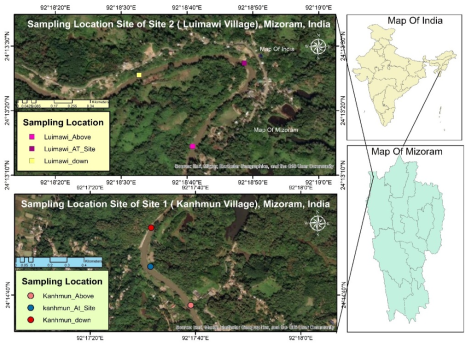
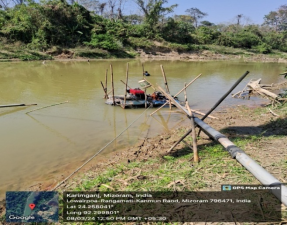
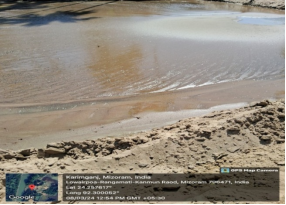
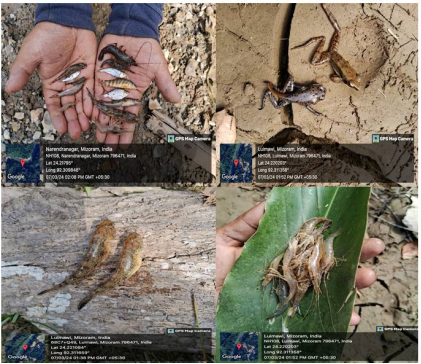
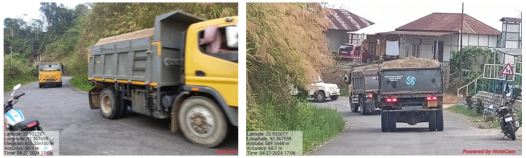
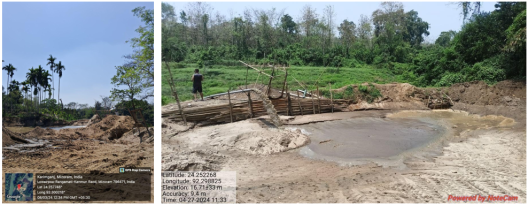



 Share This Article
 Twitter
 Linked In
 Facebook